Showing posts with label nigeria. Show all posts

Friday, July 3, 2009

New cheap flights to Lagos and west central Africa

Lufthansa air is adding another new destination to its network, expanding its services in west and central Africa. Beginning July 15, 2009, the airline will fly five times per week from Frankfurt via Accra, Ghana to Libreville, the capital of Gabon. The route will be operated by Airbus A340 and A330 aircraft with a first-, business-, and economy-class cabin.

“With the latest addition of Libreville, Lufthansa now offers customers flights to 16 destinations across Africa,” said Karl-Ulrich Garnadt, executive vice president of Lufthansa Passenger Airlines. “We are thus continuing to pursue our strategy of integrating all the key growth markets in Africa into our network.”

Gabon has extensive petroleum and manganese reserves and is an important exporter of timber. Through its trade in raw materials with companies in the United States, China, and Europe, the country has an above-average GDP. Gabon lies on the Atlantic coast of central Africa and straddles the equator. The capital, Libreville, a port city with a population of more than half a million, is the country’s economic and political center.

“Our route network is growing steadily, particularly in west and central Africa,” Karl Ulrich Garnadt explained. “Only last year, we added two new destinations – Malabo in Equatorial Guinea and the Angolan capital Luanda – to our schedule. A few weeks ago, we increased our frequencies to Angola to two flights per week.”

In addition, from July 1, 2009, Lufthansa will be serving Accra five times a week non-stop, rather than with a stopover in Lagos, Nigeria. Including the SWISS destinations Douala and Yaounde (both in Cameroon), Lufthansa customers have a choice of 31 flights per week to eight destinations in this dynamic economic region in west and central Africa.

Thursday, June 11, 2009

Tourism potentials source of foreign earnings

The MD Virgin Nigeria, Capt Dapo Olumide, has expressed the belief that tapping into the nation’s huge tourism potentials could be a major source of foreign earnings to the nation.

Olumide spoke today (10th June) in Lagos while receiving the Chairman, Tourism and Culture Committee of the House of Representatives, Hon. Kanayo G.B. Oguakwa.

According to him, “I believe that tourism can be a huge revenue earner in addition to oil, but that can only happen if well exploited. In the next ten years, with the price of oil falling steadily, I foresee tourism taking center stage in revenue earning projections.”

He noted in particular that the nation’s dependence on oil revenue earning, could be given a much needed boost if adequate energy and resources are plunged into exploiting the tourism sector.

Capt Olumide explained that a strong synergy exists between tourism and the aviation sector, explaining that available statistics show an inter-relationship in the support of travel destinations, as one aviation personnel promotes 10 jobs in the hotel sub sector of tourism.

“Nigeria tourism is a gold mine, from the Obudu Cattle Ranch to the Coal mines and slave trade routes across the country. We seriously need to develop the sector. Virgin Nigeria had on the onset of the Calabar Festival supported it, as well as the Argungu Fishing Festival; our flights helped develop that festival as a travel destination.

Hon. Oguakwu had earlier stressed the need for an improved synergy between air transport and tourism, agreeing that Virgin Nigeria had in the past four years integrated the various domestic and international tourism opportunities. He called for greater private and public sector collaboration in driving the message of the huge potential in the tourism sector.

Hon. Oguakwu also noted that the certification of Virgin Nigeria on the IOSA listing in just two years of its operation was a demonstration of the fact that it is a top of the range airline.

He further remarked that the de-branding of the Airline in the coming months would afford the airline and Nigerians the opportunity to reflect the proudly Nigerian track record of the company.

Thursday, May 21, 2009

Johannesburg - Lagos flights

The Managing Director, of the Arik airline, Mr. Mike McTighe, said at a press conference in Lagos that it had secured all approvals necessary for the commencement of the flights.

On Monday, said it would commence a non-stop daily flights between Lagos, Nigeria and Johannesburg, South Africa, its second long haul international destination, by June 1.


He said, “This is a particularly exciting development for all travellers between Lagos and Johannesburg. Our service will be operated with a newly acquired Airbus A340-500 aircraft. This allows us to offer our on-board guests the very highest levels of in-flight service.

“The airline’s first A340-500 is proving popular on its daily service between Lagos and London Heathrow. This second new airbus is configured in the same spacious layout with 36 seats in premier class and 201 seats in economy class.”

According to him, the flights will depart from the Murtala Muhammed International, Airport, Lagos, at 21.35pm local time and arrive Oliver Tambo International Airport, Johannesburg, at 04.50am the following morning.

McTighe said that the return flight would depart Johannesburg at 1.45pm local time, and arrive Lagos at 7.00pm local time on the same day.

“With our attractive on-board product, Arik is very proud to be able to now offer our service to customers wishing to travel between Lagos and Johannesburg.

“Guests in premier class will enjoy luxurious leather-upholstered seats that convert into fully flat 75-inch long beds, a state-of-the-art personal video- and audio-on-demand entertainment system and a wide 17-inch personal TV screen. Guests will also have their own in-flight bar area in which to relax,” he stated.

McTighe said its economy cabin’s seat-back entertainment, which comes in a 2-4-2 seat layout provides each guest with up to 50 per cent more legroom than competitors, saying, no passenger would be more than one seat away from the aisle.

The Arik boss also exuded confidence that the airline’s schedule would prove popular with its future customers in South Africa .

Arik will be competing against Bellview and South Africa Airways currently operating on the route. Virgin Nigeria suspended flights on the route early this year, citing economic reasons.

renting out flights to foreign carrier

Kingfisher Airlines going to rent out at least two of its five long-haul A330-223 aircraft to Nigerian carrier Arik Air Ltd for two years from the third quarter of 2009.

This indicates that the Mumbai-based carrier’s expansion plans into Europe and the US remain uncertain. It sold two of its long-haul, Airbus SAS-made A340s to Arik Air late last year when it was scheduled to take deliveries of 10 other aircraft to start international operations.
Kingfisher Airlines, India’s largest private carrier by passengers, launched only a few international flights with five of the A330s deliveries it accepted.
“All it says is that Kingfisher will not expand in the long-haul sector for at least two years,” a London-based analyst said on condition of anonymity. “It will continue to expand in the region and I expect flights to start to Singapore, Bangkok, Kathmandu and the Middle East in the next 18 months.”

The Arik Air lease will start almost a year after the two A330s, valued at list prices of $180.9 million (Rs862 crore) each, have been grounded.
Rival domestic carrier Jet Airways (India) Ltd has given nine wide-body aircraft on lease to West Asian carriers but for much shorter time.

The analyst added that the leases were an indication that Kingfisher may expand regionally unless there are drastic changes in the international market.
This year, Kingfisher has started flights to Colombo and Dhaka using its domestic fleet of ATR planes. It also has government approval to fly to Chittagong, Hong Kong, Singapore, Bangkok and plans to start an all-economy service between Bangalore and Dubai from 25 June using an Airbus A320.

On the back of a slowing economy, India’s airline firms have been facing tough times and on 13 May reported a drop of around 15% in passenger traffic in April from the year ago, showing that a contraction in air travel that began end-2007 is nowhere near ending.
At least 2,500 airline employees are expected to lose their jobs in the next four-six months from domestic carriers that are set to post a combined loss of $2 billion in 2008-09, according to airline executives and analysts, Mint reported on 3 May. This is about 8% of the total workforce employed by private carriers.
Lagos-headquartered Arik Air, which began operations in 2006, started its first intercontinental flights between London and Lagos in December using the two A340s it bought from Kingfisher. The airline is yet to make up its mind whether to buy another of Kingfisher A340s but said it would rent the A330s.
“At present we are confirmed taking two of the Kingfisher A340s. We are still considering (buying) the third aircraft,” an Arik Air spokesperson said by email.
Typically, an airline earns $2-2.2 million a month on leasing a wide-body aircraft on wet lease. A wet lease is an arrangement where one airline provides an aircraft, complete crew, maintenance and insurance to another airline, which pays by hours operated. The latter provides fuel, covers airport fees and any other duties and taxes.
If a deal is a dry lease, usually for 18-24 months, the rent is typically $1-1.2 million a month.
The wet lease will mean that Kingfisher-trained pilots and cabin crew, in conjunction with Arik Air cabin crew, will help run the new flights that will be launched by the Nigerian carrier, the Arik Air spokesperson said.


Friday, May 1, 2009

Economic Meltdown effects

The brand management industry has been touched by current world economic recession in Nigeria on a positive note. This was the view of brand experts at a press conference held by Orange Academy recently in Lagos to mark the second anniversary of the organization.

Orange Academy, the first practically oriented advertising school in Nigeria, was established in 2007 by some advertising experts in the country to train university and polytechnic graduates in areas of copy writing, graphic design, strategic media planning among others. The academy, with foreign and local industry collaboration, has graduated more than 400 students and given a sizable number of awards to corporate organizations in Nigeria since its inception.

Speaking to journalists, the Chief Imagination Officer of the academy, Mr.Kenny Badmus noted that the economic meltdown has made brand managers across the globe recognize that advertising is not the only means of marketing communication. " The economic meltdown has brought us to the point where brand mangers have begun to notice that advertising is not the only solution to brand communication. As a result of the economic meltdown, companies' budgets are becoming smaller. And because budget is small, brand managers have been forced to think more creatively and inwardly to generate results," Badmus said.

The managing director of the academy, Mrs. Chinwe Badmus, however, noted that the recent re-branding project of the Minister of Information and Communications, Prof.Dora Akunyili is a good initiative that would not only change the way Nigerians are viewed abroad, but also encourage more foreign investment into the country. She called on the federal government to involve experts from the private sector in implementing the re-branding strategy.

The registrar of the academy, Mr. Chisom Ohuaka observed that brand management has contributed to national development in the country. He argued that apart from employing thousands of Nigerians in the industry, the brand sub-sector of the economy has changed the consumption pattern of many Nigerians for the better. To this end, he noted that the academy would continue to train local experts in the field of brand advertising to avoid capital flights that resulted during bank recapitalization period as most of the experts that designed the communication strategy then were foreigners.

swine flu drug Nigeria

Twelve people have reportedly died of the disease in Mexico, while the death of a 23-month-old child was recorded in the US on Thursday.

“The Federal Government has begun the process of emergency procurement of additional doses and stockpile in case we have human cases.We are anticipating to have two million doses of the drug (Tamiflu),” Ojuolape, who answered initial enquiries by email, said. Later when our correspondent requested for further clarifications by telephone, he confirmed that government had indeed placed an order for the drug, saying, “Yes, we have placed an order for it.” He, however, did not give the cost of the drug.

He said Nigeria only had about 100,000 doses of the drug at the moment. According to him, government does not envisage that the outbreak of the disease will be massive, if it gets to Nigeria..He said, ”In countries that the disease has occurred, the total number of cases that have been recorded has not exceeded 500.”

The Federal Government has placed an order for 2million doses of a drug that will be used to tackle the rampaging swine flu pathogen in the event that it enters Nigeria, Saturday Punch has learnt. The disclosure was made exclusively to Saturday Punch after the paper made specific enquiries about Nigeria’s preparednes at the Federal Ministry of Health on Friday. The Minister of Health, Professor Babatunde Osotimehin, who spoke through his Special Assistant on Communication, Mr Niyi Ojuolape, also reiterated that there was no case of the flu in Nigeria. As of Friday, about 500 confirmed cases of the flu had been recorded in the United States; Mexico; Canada; New Zealand; Spain; United Kingdom; Germany; Israel; Austria; Costa Rica; Peru; Switzerland and The Netherlands.

Ojuolape said the country’s present stock of Tamiflu was procured last year for treating the bird flu, which recorded only one human victim in the country.

”The drugs are already in the states, but if there is any state requiring additional stocks, we have machinery with which we can get the drug to such a state.” According to him, Tamiflu, which is manufactured by a Swiss pharmaceutical company, Roche, has been distributed to 36 states and the Federal Capital Territory. He added that the drugs were stored at federal and states‘ ministries of health stores as well as some hospitals in all the states.

When asked how many people could be treated with 100,000 doses of the drug, the minister stated, ”We should remember that for Avian Flu, we had only one confirmed human case so far. We think from the past experience and lessons learnt from other outbreaks, we will not have a lot of cases.”

According to him, if a lot of cases are recorded, more procurement will be made within a very short time.

Meanwhile, as governments all over the world rush to equip their airports with thermal scanners, the Federal Government is yet to do so.

This situation is contrary to government‘s promise, at the beginning of the week, that scanners would be installed at all entry points to screen people coming into the country. Saturday Punch‘s findings showed that, rather than the sophisticated scanners, health officials are using unrealiable disposable thermometers.

Our correspondent, who paid a visit to the Murtala Muhammed International Airport, Lagos, on Thursday, did not see any thermal scanner at the arrival lounge of the country‘s foremost airport.

The thermal scanners are special scanners that screen passengers as they disembark from an aircraft, showing their body temperatures on screens monitored by health officials.

For example, some of the thermal scanners deployed in some Asian countries are configured in such a way that passengers with temperature above 37C are quickly identified and isolated.

Since high bodily temperature is one of the symptoms of the swine flu the thermal scanner is considered as one of the important first line preventive measures of stemming the spread of the flu.

Experts say that the non-deployment of the scanners could defeat the strenuous efforts that the Minister of Health, Professor Babatunde Osotimehin, has made in the last days to combat the flu. However, the minister tried to play down the importance of scanners insisting that government‘s efforts were adequate. ”There are no machines with which you can scan and identify viruses at the ports. If such scanners exist, the United States and Mexico would have installed them. It will take laboratory tests for us to identify and isolate viruses.

”What was meant was the fact that we are going to mount surveillance, through our officials at the airports so that we can detect as soon as possible the entry of anybody with the virus. Note that it is carried by humans and not necessarily airborne per se. Further to this, government has directed that all aircraft arriving the country be checked and cleaned up to ensure that both passengers and luggage have no trace of the influenza in them. Also, starting from today (Friday), port health authorities are to board planes arriving to try to identify anyone with flu with a view to clinically testing them in order to track down the entry of the flu by anyone.”

Aviation and medical experts have said that Nigeria would have to be vigilant since its people travel a lot and is a country that is visited by people from different countries. The Head, Public Affairs, Murtala Muhammed International Airport , Lagos, of the Federal Airports Authority of Nigeria , Mr. Ola Ogundolapo, said that there were flights coming into the country from the various countries the flu had affected, on a daily basis. There are seven weekly flights from United Stated of America into Nigeria through Delta Airlines. There are about 60 weekly flights from various parts of Europe to Nigeria through British Airways, Air France, KLM, Turkish Airline, Lufthansa and others. However, he said that all agencies working at the airport had been put on alert by the Federal Ministry of Health through the Public Health Department‘s Port Health Services at the Lagos and Abuja airports, and that masks, gloves and thermometer had been made available to them.

Officials of Port Heath Services at the Lagos airport, who refused to speak on record, confirmed to our correspondent that the equipment had not been installed but that they were presently using disposable thermometers to measure passengers‘ temperature. They also said that no case had been discovered yet. Experts have, however, said that using thermometers to measure passengers‘ temperatures may lead to a situation where impatient health staff may overlook those that ought to be checked. Our correspondent observed that due to the volume of passengers, it is difficult for PHS workers to test every passenger with the disposable thermometer.

The Port Health Services, which had issued an alert on the swine flu to airport managers and immigration, now has two stands located ahead of the immigration desk arrival hall, an arrangement that makes them passengers‘ first contact point.

Apply To ICF and Thomson Reuters Foundation Training Course in Zambia

The Investment Climate Facility (ICF) for Africa and the Thomson Reuters Foundation have today launched a call for applications to their groundbreaking business journalism training course being held in Zambia next month. Participants have until Tuesday 19 May to apply for the Zambian course that will be delivered in English in Lusaka from 25 – 29 May 2009.

Media organisations are invited to recommend applicants, or journalists can apply themselves, for the intensive five-day workshop which will be delivered by the Thomson Reuters Foundation. The course will broaden reporting focus and skills, as well as deepen understanding of economic and business issues of relevance to the continent and internationally.

Participants will have the opportunity to put theory into practice through numerous practical exercises and timed writing tasks. Detailed briefings, expert guest speakers, group discussions and a field reporting trip are core elements of each course. There will also be the opportunity for a select number of participants who demonstrate high potential in the introductory courses to attend an advanced two week course at a later date in either London, Paris or Lisbon.

This second of six training courses is part of Africa’s most ambitious journalist training programme, which aims to improve business, financial and investment journalism across the continent. Both ICF and the Thomson Reuters Foundation believe that greater scrutiny of investment and business issues, more timely and accurate reporting and a culture of delivering impartial news will help increase investor confidence across the continent.

ICF’s Chief Executive Officer, Mr Omari Issa, explains: “This is the third course in an important project that will increase domestic and foreign confidence and ensure more of the continent’s financial and business reporting is ‘by Africa for Africa’. The journalists who attended the first two courses have since told us that their reporting has benefitted from what they learnt and they were able to put their learnings into practice immediately after the course. We hope that business journalists from across East Africa will apply for this course. “

Lenny Njau, journalist for Kenya’s The People Daily Newspaper, who participated in the inaugural training course in Nairobi, explains: “The course was a brilliant idea and the timing could not have been much better. At a time when the world is engulfed in financial crises, nothing is more important than giving people the most accurate information. As a budding journalist, I feel much more knowledgeable and open minded in making judgements having taken part in ICF and the Thomson Reuters Foundation’s inaugural course.”

Application forms are downloadable from: www.icfafrica.org and http://www.reuterslink.org and must be received by 19 May 2009. ICF will fund all training programme fees and accommodation and media organisations will be required to cover the costs of journalists’ flights and allowances. The selection of suitable journalists will be conducted by the Thomson Reuters Foundation.

Applications will also be considered for further training sessions which will be held in Lagos Nigeria, June 22-26; Abidjan, Ivory Coast, July 27-31; and Maputo, Mozambique, August 24-28.

Wednesday, April 8, 2009

Lufthansa starts freighter services to Hyderabad

Lufthansa Cargo AG, a wholly-owned subsidiary of Lufthansa German Airlines, has started a weekly two-way freighter flight to Hyderabad from Frankfurt. The new flight augments the capacities already available on Lufthansa passenger flights.

According to Lufthansa Cargo regional manager (India and Middle East), Carsten Hernig, the German airline is the first to offer freighter service to Hyderabad. "With the new connections we can offer our customers very special routings to other fast growing markets," he said.

Though Lufthansa Cargo had been affected by the current recession, Hernig said its Indian operations were not impacted by “major adjustments of our flight schedules.”

Stating that India was still one of the most dynamic markets with high growth potential, he said Lufthansa's Chinese joint venture, Jade Cargo International, would also begin regular freighter services for the first time between China, India and Africa from April 15. The twice weekly flights from Shanghai would be routed through Shenzhen to Chennai and then via Sharjah to Lagos in Nigeria.

“With a lot of pharmaceutical products moving into the African continent, the new connection will benefit Hyderabad,” Hernig said at an event organised here to celebrate the launch of freighter service.

Chief executive officer of GMR Hyderabad International Airport Limited (GHIAL), PS Nair, said another international airline, Cathay Pacific, was also keen on starting freighter flights to the Rajiv Gandhi airport. “We can see a quantum jump in cargo handling in a couple of years,” he said, adding cargo movement from the Hyderabad international airport was expected to go up to 75,000 tonnes in 2009-10 from 53,000 tonnes in 2008-09.

Of the 53,000 tonnes of cargo handled last year, 30,000 tonnes were exported. The exports mostly comprised pharmaceuticals, solar panels and machinery.

Tuesday, February 17, 2009

High costs may force airlines to merge flights

Local airlines are already looking into signing interlining agreements with one another as hard time and competition are hitting the sector heavily.

The Assistant General Secretary, Airlines Operators of Nigeria, Alhaji Muhammed Tukur, in an interview with newsmen in Lagos, on Monday, said that three airlines, which were not receiving good patronage, were considering the option in order to mitigate the skyrocketing cost of operations.

Interlining is a voluntary commercial agreement between individual airlines to handle passengers travelling on itineraries that require multiple airlines.

This means that when a ticket is issued for an interline itinerary, one of the carriers marketing flights in that itinerary will be selected by the ticketing agent as the “plating carrier.”

According to Tukur, the global financial crisis; devaluation of the naira; and low traffic as well as high cost of operation among other challenges facing the carriers had made such an option necessary.

He said, “Airlines are really suffering. Some of them are closing routes and they are trying to interline. We are planning interlining with each other to survive.”

He explained that the interlining agreement would help airlines to overcome the problem of having to operate to a destination with less than 20 passengers.

Three airlines for instance, he said could combine 20 passengers each in one aircraft for the trip, rather than picking 20 passengers each to the same destination.

The system was said to have been first introduced in the late the early 1990s between EAS and Bellview Airlines could not work for long for reasons unknown.

Analysts say that ego by airline operators may not allow such method to hold ground in the sector.

Tuesday, January 27, 2009

Sleepless and speechless in Abuja and other cities

I have just returned from Nigeria, which in itself is not news to anybody, and I also visited our capital city, Abuja. Abuja is arguably one of the most beautiful cities in sub-Saharan Africa. If we don’t want to go that far, then it is the only beautiful city in Nigeria. It has got much about everything that a modern city should have – imposing beautiful public and government buildings; private abodes with exquisite out-of-this-world architecture (most of these are actually castles or villas, and not just houses, as only the Nigerian rich can build); the roads are neat, wide and motorable; well-planned lay-outs; relatively good security; centre of Nigeria’s government, etc.
But alas, somebody forgot to include an effective, cheap public transportation system for the common man - rail, buses or any other. As a Nigerian, I am always awed and proud of it, but with mixed feelings and reservations. I am always at a loss why no Nigerian government has ever considered replicating Abuja in other state capitals around the country.
They would not, would they? Abuja is a “planned city”, as it was mainly built in the 1980s and officially became Nigeria's capital on 12 December 1991, replacing the role of the previous capital Lagos. As of the 2006 census, the Federal Capital Territory has a population of 778,567.
Abuja is known for being the best purpose
-built city in Africa as well as being one of the wealthiest and most expensive. The logic used for conceiving Abuja, by the Murtala Mohammed-Obasanjo military regime of the late 70s, was similar to Brazil building its capital Brasilia.
It is of course not my first or second time in this city built with the wealth Nigeria has gained from oil, and the sufferings of the people of the Niger Delta (Sorry to put a dampener on your sensitivities).
Indeed the residents of the real Abuja are not ordinary Nigerians.
Whenever I visit Abuja, I could not but help being overcome with mixed feelings. One, and the positive thing, is that Abuja is a testimony to Nigeria’s effort to be a modern state, and one that a Nigerian should be proud of.
The second, and definitely negative of disheartening, is that Abuja represents man’s inhumanity to man, in all its ramifications.
It is a testimony or evidence to the monstrous, contagious and murderous corruption of Nigeria.
A testimony to the debilitating effect that corruption has had on us since the military took over governance of this country. It is the evidence of greed, insincerity, mismanagement and bad governance of our country. It embodies the desire and effort of the corrupt ruling class that have enslaved their people for decades. Look at it beyond the issue of beauty and modernity.
Every time I visit this city, and talk to people, it is always the same sense of futility and pessimism, and incidentally, these are expressed by both the ordinary Nigeria on the street as well as those in various levels of the society – civil servants, politicians, private and business people.
All of them believe that the deliverance of this country is only by praying to God. They all believe, and these include those in Lagos, Ibadan, Ortukpo, Kano, Kaduna, Benin, Minna, Yola, Jalingo.
Ogbomosho, Calabar, Sokoto, Ife, Ado-Ekiti, Warri, etc, that only God can save Nigeria.
Mind you, I am a fairly religious person. At least believe in God, even if I don’t attend church regularly as my mother would have liked me to do, but I have a problem reconciling this “given-up” attitude of my countrymen that only God can deliver them from the evil cabal that is ruling them.
They do not believe that they, as a people, can and have to do it themselves. And I am talking about even the people who should not be saying such things.
I am talking about people, whose remit is to ensure the smooth running of Nigeria, either as civil servants, politician, military personnel, police, business people and the likes. One thing that comes to mind is that these same people are either being deliberately insincere with me and their countrymen and women, or they really do not know what to do.
Either way, we all know it does not bode well for the country, and explains, almost graphically, why the country is in such a mess as we find ourselves in today, and in the future too.
On the other hand, such sentiments shows us to be pessimists and a people, at least those ordinary Nigerians, who have no other choice than to live and struggle it out in Nigeria, who have given up on the country itself and are convinced that Nigeria’s salvation can only come from God.
Well, I agree that God can indeed save us, but I always ask them; have you heard of the saying that “heaven only helps those who help themselves”?
Abuja, being our capital city, is supposed to be an
embodiment of Nigeria, and Nigeria, in all ramifications – culture, politics, socio-political development, a testimony to a country rousing itself out of the ashes of civil war, religious riots and ethnic rivalries, on its way to being a modern and developed country. But no, you cannot see all these and many features of political and democratic emancipation in Abuja. What we see is a vagrant display of stolen wealth, outright oppression, arrogance of power, unchecked political, governmental and moral corruption, neglect of fellow Nigerians and all the vices that have virtually destroyed our nation, and turned the majority of Nigerians into paupers and/or crooks Well.
People tell me that the success of Abuja lays solely on ex-President Babangida, since it was him, more than any previous Head of State, who accelerated the building of Abuja and forced the civil service, the diplomatic corps, etc, to move into the partly-completed city in the 80s.
I might begrudgingly accept that, but then it is no wonder that the city is decadent like its “accelerator”.
What do we know? A lot of Nigerians made their money out of the building of Abuja, and are still making money, because the city is actually not complete and is still growing. All these to the grief of the Niger Delta people; no wonder they are aggrieved.
Can you blame them? However, it was for selfish reasons that IBB accelerated the building of Abuja.
He made that decision shortly after the Orkah coup, in which he was nearly bushwhacked and killed.
He surmised that Lagos, as the capital of Nigeria, was not safe for him, especially since he did not have plans to relinquish power for a long time, and made haste to retreat to the relative safety and proximity of Abuja to his Minna hometown as well as to the Nigerian Army facilities in the northern part of the country.
Also he could exercise better control of the armed forces from Abuja, instead of the coup-hardened soldiers based in Lagos.
Abuja typifies some of the failings in our society which, according to Tunji Lardner, has enough for everybody’s need but not enough for everybody’s greed; a society where the greed (of the elite) most often surpasses the need (of the populace).
You cannot be an ordinary citizen of Nigeria and live successfully in Abuja. The city is for rich, mostly corrupt Nigerians. All other people live on the outskirts of the city, called “satellite towns ”, and come into the city to satisfy the whim and services of the rich. The ostentatious ness and pretentiousness of the city are overwhelming.
The rotten smell and evil face of corruption are overpowering, nauseating and cannot be ignored, if you are not “one of them”.
But Nigerians seem to love it that way.
Mind you, I am not against being rich.
I would like, and work hard, to be rich too. Why not? I am just against corrupt enrichment. And that is what we have in Abuja.
Babangida, and subsequent leaders of Nigeria to date, ensured that living in Abuja is beyond the reach of the majority of Nigerians; not that I want 140 million Nigerians to crowd into Abuja, but you know what I mean. If a plot of land costs between 30 and 40 million naira, what would you build on it, for example? You had better build a castle.
The corrupt rich have cornered the real estate market. They have all the houses and the estates.
Most of these are politicians and ex- military leaders and civil servants.
Even the commercial properties are owned by them.
In fact, anything that is not government property is probably owned by these individuals.
I cannot know or list them all, but here’s an example. There is a large expanse of building called Sigma Apartments (I forgot which street it lies) and I was told it is owned by an ex-Minister for Sports.
See? That tells you why our football and other sports are spiraling downwards every day.
Several high quality hotels, guest houses, shopping complexes and plazas are owned by ex-military officers and serving politicians. And these people do not own one, but several each. In most of the “ big men’s” castles, you can count up to six exotic vehicles, while Abuja itself has no public transportation worth its name for the masses to travel in to and from work. Babangida forgot to include a mass transit or urban rail system in his master plan.
This rapacious land-grabbing and property- acquisition frenzy reminds me of Leo Tolstoy’s short story “How much land does a man need?” This was the story of a man, Pakhom who already had some land but went in search of more land, this time, freehold land, until he got to the land of the Bashkirs, where he was told he could take as much land as he could walk around in a day at the rate of a thousand rubles a day, but he must be back at his starting point everyday, by sunset. But Pakhom got greedy.

shopping and enjoy your holidays in Lagos

Besides an ongoing flea market that sprawls through the streets, Lagos boasts numerous fascinating shops and boutiques, especially in the pedestrianised old city. Browsing is as pleasurable as buying in the well-stocked shops that are bristling with attractive local wares, from wickerwork to filigree jewellery, copperware and leather goods to wine and pastries.

There is little need to do anything more to enjoy your holiday other than sprawl on the sandy beach with an occasional dip in the ocean, but those who need more activity can choose between dozens of pursuits like sailing, wind-surfing, fishing, para-sailing, microlight flights and scuba diving. Golf is a major attraction here as it is throughout the Algarve, with the Palmares and Alto courses nearby, offering a round with sea views. There is also the challenge of the Penina Championship Course, site of many a Portuguese Open. Those who hire a car will be well-rewarded in exploring the adjacent coastline and seeking out unspoilt villages and beaches. There are also a few sightseeing opportunities in the town, including an interesting museum.

Tinapa as the pivot of tourism in Nigeria

From all that is gathering around Nigeria’s socio-economic atmosphere, it is quite apparent that the country is at the threshold of an important revolution and transformation in her tourism industry following the advent of Tinapa.

For the first time, Nigeria republic can now boast of a world class business resort, capable of not only changing the ugly visage of the country but also attract enormous investment; an outcome of which will skyrocket her annual GDP.

Understandably, the project was initially dismissed as impossible, unrealizable and a figment of Governor Donald Duke’s imagination owing to the fact that very little in previous administration was accomplished in transforming the tourism industry to a state of the art resort for tourist pleasures.

However, what is consoling about this is that the tourism potential of Cross Rivers State cannot be underestimated and as long as it remains, it will be the backbone of the resuscitation of the erstwhile ailing tourism industry in the state and by extension Nigeria.

Hence, the revamping of the moribund Obudu Cattle Ranch was a step in the right direction for the state. This has become a source of pride for Nigerians and not only for the Akwa Ibomites alone as it is designed to capitalize on Nigeria’s fast growing economy to put Tinapa in the mega-league of global trading centres.

The project, apart from the business aspect offers so much potential for tourism. To complement the already existing leisure and attractive areas, is the breathtaking Studio Tinapa built over an area covering over 55,000 square metres, first of its kind in the country, commissioned recently by President Olusegun Obasenjo. The Tinapa studio was built in collaboration with Dream entertainment, a United States based production and distribution outfit.

The amphi-theatre studio designed for shows and recording purposes of local and foreign productions in Nigeria for feature films, TV shows, dramas, and other related productions. The huge film studio is fitted with a fully adjustable crossover lighting grid with all the facilities of a modem theatre.

Tinapa offers an umbrella for varied economic activities. Its four giant anchor emporiums cover a vast area exceeding 40,000 square metres of trading space. It provides an enabling environment for entrepreneurial sustenance and development. The four emporiums offers profound range of opportunities such as space for banking, furniture showroom, tile show rooms, Internet Café, Telephone and Outdoor Showroom.

Ample spaces have also been allotted for vehicle showrooms, lifestyle, hardware, motor accessories, sports goods, linens and fabrics, toys, speciality and stationery. It is wide range shopping tenantries that include office equipment, Books and music shops, Supermarkets, fish market, fruits and vegetable or grocery store.

There are also shops for travel agency, pharmacy, tobacconist shop, speciality, photographic, car hire and dry cleaner. Others include courier service, optometrist, textiles, fashion, branded fashion, ladies shoes, Gents shoes, hair dressers as well as specialist fashion.

Household items that have shopping space provided for them include furniture, bedding and mattresses, lighting, home accessories, appliances and electronics, art and framing. Shops are also allotted for specialist items such as jewelry, cosmetics, children’s clothes, specialty audio, leather and luggage. Enough space has also been allotted for potential tenants to showcase computer and their accessories.

There are also line shops for boutiques, restaurant, outdoor sports, beauty therapy, and camera sports. Others are fast foods, electronics, optical, toys and hobbies, arts and curious, lingerie as well as confectioneries. In Tinapa, it appears that virtually no item that is not given consideration.

Other major attraction of the Tinapa wonder world includes its vast arrays of leisure and entertainment facilities.

These include the Tsogo Sun International Casino, and the 300-room Southern Sun Budget Hotels. There is also the Entertainment centre including eight movie theatres. Nature is brought down to earth with a fisherman’s village which consists of themed bars nightclubs, and an art craft village. The entertainment orbit is not complete without the international movie studio.

For sports facilities, there are children’s play area, tennis and volley ball courts, games arcade and ten pin bowling alley. The eatery orbit comprises world class restaurants, and food court with take away outlets. And immensely mesmerizing is the world class water world theme park.

To support the magnificent facilities in Tinapa, the outgoing Duke administration in Calabar had planned to put in place wonderful infrastructure that will make Tinapa truly world class. The Resort has been created as an exclusive environment that is totally supportive of global trading.

Another hallowed component of this stupendous infrastructure is the airport which is being upgraded to international standards to corroborate the impending flow of tourists as it translates to a business and tourism hub for the entire West Africa sub-region.

A minor-rail system which carries passengers is to connect Calabar international Airport, direct to Tinapa. It is envisaged that the excellent facilities offered by the Calabar Port which is currently being dredged will be able to accommodate large container ships, allowing tenants to easily bring goods to Tinapa.

Tinapa is also guaranteed constant supply of electricity through an Independent Power Programme. Security is guaranteed through an internal security unit, using the latest surveillance, monitoring and access control mechanisms. In Information Technology, Tinapa assures of the best of breed ICT infrastructure, including telephoning, data, POS.

Already, Tinapa has started attracting partners. MTN Nigeria Communications Ltd announced its latest strategic move to clinch up a market deal as the official Telecoms partner of the Africa’s Premier Business Resort.

As the official Telecom partner of Tinapa, it would be granted rights to provide telecoms services to the entire Tinapa business resort. It already has an ultra modern connect store.

Tinapa Business Resort is located within a unique Tax free zone offering numerous benefits to tenants. It allows retailers to import, free of duty, capital goods, consumer goods, raw materials, components and articles. It offers excellent opportunities to investors, including exemption from all federal, state and local taxes, unrestricted repatriation of both dividends and capital.

Tinapa Business Resort effortlessly combines business with high velocity leisure. To support the hotel is an array of professional services and offering amenities such as sickbay, management offices and so on.

There is a warehouse cluster with five warehouses, leisure land, water world facility, wave pool, standing wave surfing, lazy river ride, water slides, and picnic area, among others. There is accommodation for associated facilities such as lifeguard tower, kiosks, and other management offices.

Tinapa is a compendium of optimal resources to become an open reality. From the opulence of materials used and the palatial impression it sends down the spine of any tourist on a first time visit, it’s all too much to underestimate the painstaking effort of the eminent governor of the state and his people. Although, the relentless and hard work of the typical Calabar person cannot be undermined, this is the crux of their hard work and selfless dedication to the development of their potential. And have ever since internalized the principle as a way of life, thus sending positive signals to the world, and to Nigerians in diaspora.

Project Tinapa is remarkable in all respects, talking about its outlook. The design for Tinapa is breathtaking and audacious in its scope; it drew inspiration from a range of finest designs in the world.

Cross River State is certainly not the richest state in the country, it is one of the poorest in terms of available resources. It does not have the petrol dollars of the typical oil rich Niger Delta States nor the vast economic base of Lagos. Yet, it has been able to create a wonderful facility such as Tinapa which will continue to employ thousands of Cross Riverians and other Nigerians.

It is examples such as this, one wished other governments would emulate just as one fervently hopes that Governor Duke’s successor in Cross River State will continue from where he stops in Tinapa. So far only a percentage of the huge vision in Tinapa has been achieved. The dream must not die.

U.S. Justifies Nigeria Travel Advisory

Acting Assistant Secretary Bureau of African Affairs, U.S. Department of State Charles Snyder, has explained that the travel warning issued on Nigeria was due to a combination of factors including U.S. government concerns about the domestic situation in Nigeria as well as links to global terrorism. He also described Africa as an 'important" but not "crucial front" in the global war against terrorism.

Responding to a question by THISDAY on whether the December 2003 travel warning update issued on Nigeria was due to the domestic situation or a global terrorist threat, Snyder replied, "It's a little bit of both", adding that Nigeria is " not currently the kind of place that somebody that's unsophisticated should go".

He had earlier explained that US Department of State was compelled to warn American citizens about traveling to Nigeria because of the general terrorist threats throughout the region, the "problems up in the western states" as well as the "unfortunate problem that has nothing to do with terrorism on one of the airlines". He, however, added that he was hopeful that the problems would be resolved.
On Africa's role in the global war on terrorism, Synder described Africa as important "but it's not a crucial front." He said: "The old camel caravan route coming down from Libya all the way through Mauritania is an area of interest and an area of trouble which extremists can use, and we're paying attention to in this global war."

Briefing on Sub-Saharan Africa, Snyder acknowledged that President Bush had fallen short in the implementation of his pledge of $15 billion over five years to fight HIV/Aids in Africa and the Caribbean.

"$15 billion divided by five should be $3 billion a year" he said adding that the $2.4 billion Congress approved for fiscal year 2004 "didn't quite get there." He, however said, that the government had "engaged that in a serious way."

He denied that the delay by the Bush administration in pushing for an extension of the African Growth and Opportunities Act (AGOA) is to Africa bank for its stance at Cancun last September, when discussions broke down over disagreements between the US and developing nations at the world trade meetings.

"What happened at Cancun is unfortunate in many ways," he said, "but AGOA legislation is not affected by that, trust me." Trade bills are always tough to negotiate, especially in an election year, so the State Department traditionally waits "until the 11th hour to spot what we like best," he said.

Snyder also said the Bush administration wants South African President Thabo Mbeki to put more pressure on Zimbabwe's President Robert Mugabe stressing that time was important in the peaceful resolution of what he described as "a tragedy unfolding". "We've seen South Africa step up to the plate in Burundi," he said, where a peace agreement is close to resolution "in large part due to South Africa's energetic diplomacy." The U.S. government would like to see similar movement on the Zimbabwe issue, he said. "We're still hoping that President Mbeki will step up. With a tragedy unfolding like this, time is of the essence and we're hoping that he takes a re-energized look."

Yankari National Park of Nigeria - The Best Park for Observing Wildlife

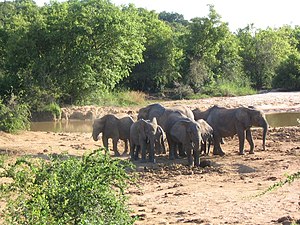
Yankari is Nigeria's best park for observing wildlife. With a bit of luck you may come across buffaloes, waterbucks, bushbucks, hyenas, leopards, plenty of baboons and the odd lion. While the park's animal population has suffered from poaching it still has some big draw cards like the 500-strong population of elephants and the bird-watching is excellent.

The best time to see animals is from late December to late April, before the rains, when the thirsty animals congregate at the Gaji River. You're permitted to drive your own vehicle if you take a guide, otherwise the park has a safari truck that takes two hour tours.

Yankari's other great attraction is the incredibly picturesque Wikki Warm Spring, near the park campsite. The crystal-clear mineral water is a constant 31°C, forming a lake 200m long and 10m wide and great for a swim.

Beaware from the Scams and Warning in Nigeria during Tour

Expect to pay bribes to police officers. It's often cheap - abut 100 naira. A request for a bribe often comes with this sentence "anything for us for the weekend". The bribe situation gets worse as you travel deeper into Nigeria and towards Benin.


Expect delays at the Seme border post (often closed because of corruption). There, requests for bribes are blatant and increase in value depending on your race and country of origin. You will be arrested several times, have a few arguments but in the end you pay the bribe to get your passport back. On the Benin side of the border things are pretty much the same - so make sure you have some CFA or naira - never flash any foreign currency like dollars - this is asking.

Tuesday, January 6, 2009

No Country Pilgrim Stranded in Saudi Arabia -Nahcom

THE National Hajj Commission (NAHCOM) says no Nigerian pilgrim would be stranded in Saudi Arabia after the completion of all hajj rites in the holy land.

A statement from NAHCOM indicated that more than 65,682 pilgrims have been airlifted back home, representing 77 per cent of all pilgrims who performed this year's hajj to the holy land.

Federal hajj commissioner in charge of policy, personnel management and finance, Alhaji Liad Tella, in the statement, noted that the targeted final airlift of Nigerian pilgrims back to Nigeria is on or before January 6, 2009 under the principle of first come, first to leave. Liad stated that 164 flights had been operated on the return leg, adding that 254 flights were operated during the outbound journey.

"The number of flights might be increased due to the introduction of five additional 747 aircraft to replace the 752 used. More flights have been made to Nigeria by the airlines since last Monday while seven flights of Boeing 747 have been leaving for different airports in Nigeria daily since Saturday, December 20, 2008, "the commissioner said.

He disclosed that less than 19,318 pilgrims out of the 85,000 that performed the hajj were still in the Kingdom of Saudi Arabia, pointing out that efforts were on to ensure that all the pilgrims were airlifted back to Nigeria even before the January 6 deadline.NAHCOM chairman, Alhaj Mohammed Bello, had maintained that the rule of first come first to go must be obeyed and followed. "No pilgrim is bigger than the other before Allah," he said.

Meanwhile, Med-View Airlines, one of the carriers for the hajj operations, said it concluded the exercise yesterday with the arrival in Lagos of 675 pilgrims in two separate flights. The passengers, according to the company, were the last batch of pilgrims drawn from Edo, Osun and Oyo States who arrived in Boeing 747 and 757 into the waiting hands of their State Pilgrims Welfare Board officials, relations and friends gathered at the Hajj Camp of Murtala Muhammed International Airport, Ikeja.

US officials to inspect Nigerian airlines, NCAA

A team of experts from the United States of America’s Federal Aviation Administration is due to arrive in Nigeria on Wednesday (tomorrow).

The US officials are coming to carry out another round of a comprehensive audit of the Nigerian aviation industry, which it started last year. They will also determine if the country qualifies to be upgraded to the coveted Category One status.

Nigeria is currently rated Category Two by the US FAA, and an upgrade means Nigerian carriers can operate direct flights to US destinations.

Only three countries in Africa – South Africa, Ethiopia and Egypt, are presently certified as Category One.

Arik, Virgin Nigeria and Bellview Airlines have been designated on US routes to reciprocate the Bilateral Open Skies Agreement signed with the US in 2000.

An American airline, Delta, is already flying into Nigeria. It was formerly two until North American Airlines pulled out last May, citing record high oil prices as its reason.

The audit, also known as the International Aviation Safety Assessment, is expected to measure the extent of Nigeria’s compliance with the safety and security standards of the International Civil Aviation Organisation, the global regulator, and that of the US FAA.

The US initiated the IASA programme to ensure that country’s aviation sector with which it has direct links, meet the ICAO and US safety standards.

The Media Assistant to the Director-General, Nigerian Civil Aviation Authority, Mr. Sam Adurogboye, told our correspondent on Monday that the team, this time around, would be looking at the three designated Nigerian airlines as well as the NCAA.

He explained that the US FAA officials would be examining some “eight critical elements and the corrective action plans as per identified open items.”

Adurogboye assured that that whole exercise would be over this year, and that the country was on the verge of attaining the prized status.

He said, “We are confident, we will come out shining. The NCAA is fully prepared for the audit. We have prepared the designated airlines also-Arik, Virgin Nigeria and Bellview.”

Direct flights to US and other regions should help the Murtala Mohammed International, Lagos move a step further towards becoming a regional hub and also to grow both passenger and cargo traffic.

Presently, Kenya, one of the fastest growing aviation hubs on the continent, is also putting a lot of measures in place to attain the US Category One certification.

Countries that meet up with the US FAA conditions would have met up with ICAO safety standards as the Category One is rated higher than standard.

The establishment of ICAO after the Second World War included a commitment by signatories to abide by common safety measures in international air transportation. The organisation, however, has limited powers of enforcement.